After the Immaculate Conception (1854): The Impact of Catholic Marian Dogma on the Tradition of the Dormition and the Orthodox Response
(The English version follows the Chinese version)
在基督教神學史上,1854年是一個深具分水嶺意義的年份。是年12月8日,教宗庇護九世頒布《莫可名言之天主》(Ineffabilis Deus)宗座憲章,正式宣告聖母無染原罪為天主教當信之理:「至福童貞瑪利亞,在其受孕之第一瞬間,因全能天主所賜之獨特恩寵與特權,鑑於人類救主耶穌基督的功績,被保存免受原罪的一切玷染。」這一信理雖在天主教內部經歷了漫長的神學醞釀,其正式定義卻對東方正教會構成了一次深刻的神學挑戰。
在此之前的漫長歲月中,東西方教會共享著一個更為古老的傳統——每年八月十五日紀念「聖母安眠」(Dormition)。這一傳統可追溯至公元五世紀甚至更早,其核心內涵極為清晰:聖母真正經歷了死亡,她的身體被安葬於墳墓,隨後她的靈魂與肉身被她的聖子遷移至天上。這是一個關於「死亡—復活」的奧蹟,以聖母為原型,預示著所有基督徒末後復活的盼望。
然而,當「無染原罪」正式進入天主教的信理體系後,一條新的神學邏輯鏈條開始形成:若瑪利亞完全免於原罪,則她亦不當承受原罪帶來的刑罰——死亡的腐朽。這一邏輯在近一個世紀後開花結果:1950年,教宗庇護十二世頒布《廣賜恩寵的天主》(Munificentissimus Deus),宣告聖母升天為信理,並明確將兩條信理綁定——「她藉無染原罪完全勝過了罪惡,因此她不受遺體歸於塵土、等候終末肉體救贖的律法之約束。」
本文章擬從東正教視角出發,以論文形式考察天主教「聖母無染原罪」信理定義之後,如何在神學層面衝擊並重塑了「聖母安眠」這一古老傳統的理解框架,並系統闡述東正教的神學立場與回應。
1「聖母安眠」的古老傳統:死亡作為榮耀的通道
安眠傳統的起源與內涵
「聖母安眠」傳統的歷史根基遠早於任何教義定義。早在公元五、六世紀,聖默利托(Saint Melito of Sardis)、聖狄奧尼修斯(Saint Dionysius the Areopagite)等人的著作中已記載了對聖母安眠的記念。及至第八世紀,大馬士革的聖約翰(Saint John of Damascus)與其兄弟聖科斯馬斯(Saint Kosmas)在他們的講道中,對這一傳統作了詳盡的神學詮釋,為後世奠定了經典表述。
根據教會傳承,聖母在晚年居於耶路撒冷,由聖若望(使徒)奉養。在她離世前三日,天使長加百列向她顯現,告知她即將遷移至永生。眾使徒被雲彩從地極聚集至耶路撒冷,親眼見證了她的安眠。三日後,當使徒多馬遲來,眾人打開墳墓,卻發現聖母的身體已不復存在——聖子已將她接至天上。
「安眠」神學的精髓:死亡的真實性
這一傳統的核心在於一個看似樸素卻至關重要的命題:聖母親身經歷了真實的死亡。大馬士革的聖約翰寫道:「如果她那不可理解的果實——她因此被稱為天——自願屈身於凡人的墳墓,那麼她這位未經人道而生下祂的人,又怎能拒絕死亡呢?」他進一步解釋:「由塵土所造之物,理應歸於塵土,然後才能進入天國。她在世上藉著克制肉體,懷著最純潔的生命,已然擁抱了天國。」「身體必須經過死亡而得潔淨,如同黃金經過火煉,脫去一切黑暗與污穢的粗重負擔,然後從墳墓中復起,成為不朽、純淨、並被永生的光輝所照耀。」
在東正教的禮儀中,這一信念得到了最為生動的展現。聖母安眠節的集禱頌(Kontakion)宣告:「墳墓與死亡都不能拘禁誕神女——那不止息的盼望、永不懈怠的代禱與庇護者。身為生命之母,那位曾居住於她永貞母胎的主,已將她遷移至生命之中。」奧德第九首讚詞同樣宣認:「從童貞女的誕生與死亡,已成為生命的保證。」
「安眠」而非「升天」:術語的神學意義
值得注意的是,東方傳統刻意選用「安眠」(Dormition)而非「升天」(Assumption)來描述這一奧蹟。羅馬尼亞宗主教達尼爾(Patriarch Daniel)曾明確闡釋:聖母的遷移(translation)既非復活——因為她並未如基督般以復活之身向眾人顯現,亦非升天——因為她並非憑己力上升至天,而是被她的聖子所接納。
俄克拉荷馬城的聖彌額爾正教會進一步說明了「安眠」與天主教「升天」在神學上的關鍵區別:天主教1950年的信理定義並未明確斷定聖母是否真正經歷死亡,僅言「完成了她塵世生命的歷程」;而正教會的教導則堅定地確認她的確死了。「她完完全全地分享了我們人類的處境。但死亡無法拘禁她。基督使她復起,正如祂將使我們復起一樣。我們也不將此定為天主教意義上的信理。這不是某位教宗在1950年宣告為不可錯誤的道理。這只是教會一直以來所相信、所祈禱、所詠唱的內容。」
2 從「安眠」到「升天」:無染原罪信理對古老傳統的重塑
無染原罪的神學邏輯與死亡難題
天主教1854年無染原罪信理的核心命題是:瑪利亞自受孕之始,便被保存免受原罪的玷染。這一命題植根於奧斯定式的原罪論,認為原罪不僅是敗壞的狀態,更帶有某種罪咎(guilt)的性質,透過生育而傳遞給所有人類後裔。
然而,這一信理的確立隨即引發了一個無法迴避的神學問題:如果瑪利亞完全無染於原罪,那麼她是否還需經歷死亡——原罪的工價?如大馬士革的聖約翰所強調的,死亡是墮落人性的普遍後果,聖母既分享了人的本性,便理當與所有人一樣經歷死亡。但在無染原罪的框架下,聖母的人性處境與其他人類之間出現了一道根本性的裂痕。
天主教護教學者在這一問題上面對進退兩難的困境。一方面,若承認聖母經歷了死亡,則似乎承認原罪的後果觸及了這位無染原罪者;另一方面,若否認聖母死亡,則聖母與基督之間的類比關係便可能越界,賦予她某種近乎神性的地位。這一困境導致1950年《廣賜恩寵的天主》在措辭上刻意選擇了模糊表述——「完成了她塵世生命的歷程」——既未明確斷言死亡,也未否定死亡。
「升天」信理對「安眠」的系統性置換
1950年聖母升天信理的正式定義,標誌著天主教對古老「安眠」傳統的系統性重塑。庇護十二世在宗座憲章中明確將無染原罪與升天結為一條不可分割的神學鏈條:因為瑪利亞無染於原罪,所以她不受肉體腐朽之律的約束,無需在墳墓中等候末日復活。「這兩項特恩彼此緊密相連。」
在此邏輯下,「安眠」的核心——聖母的真實死亡——逐漸被淡化甚至被質疑。天主教護教學者如W.L. Grayson指出,天主教會內部長期存在一種觀點,認為死亡是原罪的後果,既然瑪利亞完全無罪,死亡便無理由觸及她;若要解釋她的死亡,便只能參照基督自願經歷死亡的範式——即瑪利亞並非必然經歷死亡,而是自願選擇跟隨其聖子進入死亡。這一解釋表面上保留了「死亡」的話語,但實際上從「必然」轉向「自願」,已經從根本上消解了「安眠」傳統中聖母作為人類代表所經歷的「與眾人一樣的死亡」。
更為顯著的變化發生在禮儀與術語層面。西方教會逐漸以「升天」(Assumption)取代「安眠」(Dormition)作為此節日的正式名稱,神學重心從「死亡—復活」轉向「直接升天」。正如美國正教會神學家約翰·布雷克(John Breck)神父所觀察的:「西方若干真誠卻被誤導的聖母詮釋傾向於將至聖童貞女高舉到一種『神性』的層次,實際上抹去了人與神之間至關重要且絕對的分別。」
「先贖論」與恩寵的「自動化」趨向
天主教神學家董思高(Duns Scotus)提出的「先贖論」(Preredemption)試圖調和一個明顯的張力:若瑪利亞在受孕之初即免於原罪,則她是否還需要基督的救贖?董思高的解答是——瑪利亞同樣需要救贖,只是她以一種更為卓越的方式在基督的功績中「預先」獲得了這一救贖。
然而,從東正教的視角來看,這一推理路徑的問題在於:它悄然將恩寵的行動從一種人格性的相遇與合作(synergeia),轉變為一種自動生效的本體論屬性。君士坦丁堡普世宗主教巴爾多祿茂(Bartholomew)在接受採訪時精準地指出了這一差異:「對我們正教徒而言,原罪所傳遞的是敗壞,而非合法的罪責或道德性的玷污。」「至聖誕神女並非從受孕之初就被免除原罪的敗壞;她乃是盡心愛天主、遵守祂的誡命,因而藉著那位從她取得肉身的耶穌基督而被天主所聖化。」「她在基督內的重生,如同所有聖徒一般,使她得以被聖化於一切聖徒之上。她那恢復墮落前狀態的過程,並非必然發生在受孕的那一刻。我們相信,這一過程發生在後來,是藉著未受造的聖寵在她內逐步運行,並透過聖神的降臨——即基督在她內受孕的那一刻——使她得以從一切玷污中得以潔淨。」
因此,對東正教而言,「安眠」中的死亡並不與聖母的純潔構成矛盾——因為她所承襲的,是墮落人性共通的敗壞(包括死亡),而非某種需要預先洗去的「罪咎」。恩寵並非一種對「原罪玷染」的法律性豁免,而是與天主之間的人格性合作之果實——這一合作在她一生的自由抉擇中逐步深化,至其生命終結時達於圓滿。在此框架下,「安眠」恰恰是這一合作的最後、也是最高的一環:她在死亡中經歷了與基督同死、同復活的逾越奧蹟。
3 東正教的反駁與神學立場
拒絕「無染原罪」的聖經與教父依據
東正教對「無染原罪」的拒絕並非始於1854年,而是在信理被頒布之後才變得更加系統化和明確。在此之前,東正教內部對聖母的受孕是否存在任何不潔曾有過某種開放性的探討,但1854年天主教的定義使這一問題從一個自由的神學探討(theologoumenon)轉變為教義層面的分界線。
君士坦丁堡牧首巴爾多祿茂在上述訪談中明確表達了東正教的立場:聖母乃是「藉著對天主的愛與純潔——理解為一種不可動搖、毫不猶豫地將她的愛完全奉獻給唯一天主——她才能在天主的恩寵中,於基督內聖化自己,並使自己配得上成為天主的居所,正如天主期望我們每個人都能成為居所。」「我們正教會尊崇至聖誕神女高於一切聖徒,但我們並不接受她的無染原罪這一新信理。」
此一立場的聖經與教父依據可以從兩個層面予以說明。在聖經層面,正教教父認為路加福音的「萬福,充滿恩寵者」(路1:28,天主教譯法)並不支持「受孕之初即免於原罪」的解讀,而是表明了聖母因其順服與信德而在天主面前蒙受恩寵。在教父層面,大馬士革的聖約翰屢次強調聖母經歷了「合乎本性」的死亡——她來自「必死的腰中」,她所承受的死亡乃是為了「安慰所有人,使他們不至於懼怕經過死亡之門進入天國。」聖厄弗冷、聖金口若望等其他東方教父同樣並不將聖母的純潔追溯至受孕之瞬間,而是強調她在天使報喜時因聖神的降臨而得以聖化。
原罪論的根本分歧及其對「安眠」神學的影響
東西方教會在「聖母安眠」問題上的分歧,遠非孤立的聖母論議題,而是深刻地根植於雙方在原罪論上的結構性差異。
奧斯定式的「原罪」(peccatum originale)概念強調亞當的罪咎透過生育而遺傳給所有人類後裔,人性因此承受了「玷染」。在這一框架下,瑪利亞若要成為聖言的純潔居所,便必須在受孕之初即被免除這一玷染——無染原罪成為神學邏輯上的必要命題。而一旦確認了無染原罪,則原罪所帶來的刑罰(死亡的腐朽)便同樣不能觸及聖母——升天信理隨之成為必然的推論。
然而,東正教對「先祖之罪」(προπατορικὸν ἁμάρτημα)的理解有別於西方的「原罪」概念。牧首巴爾多祿茂在其專文中詳盡闡明:「天主肖像是人類被塑造的模樣,具備與天主相似的潛能與命運。人類藉著自由地選擇對天主的愛與服從祂的誡命,即使在亞當和夏娃墮落之後,仍可按照天主的旨意成為天主的朋友;然後天主會聖化他們,正如祂在基督降生以前聖化了許多先祖,儘管他們的救贖——即從敗壞中得釋放——是藉著基督的道成肉身並透過祂才得以完成的。」東正教認為墮落的後果是死亡和敗壞的傾向(inclination),而非個人性的罪咎遺傳。在此框架下,聖母與所有人類一樣承受了墮落人性的共有後果,包括肉身必然經歷的死亡。她之所以純潔,並非因她被免除某種「玷染」,而是因她以其自由意志選擇了全然順服天主,從未犯任何實際的罪,並在天使報喜時因聖神的降臨而獲得終極的聖化。
由此,「安眠」中的死亡不僅不與聖母的聖德相抵觸,反而構成了她作為人類代表的關鍵屬性:她「與一切地上所生的人同受此份」,以其肉身經歷了亞當後裔共通的死亡,從而成為一切在基督內同死同復活之人的「原型」。弗拉基米爾·洛斯基(Vladimir Lossky)曾指出,在東正教的視野中,聖母安眠是「第一個在基督內實現的末世論事件,預示著普世復活。」
「安眠」作為拒絕「教義發展」論證的表徵
東正教對天主教定義「升天」信理(1950年)的態度,與其對「無染原罪」信理(1854年)的拒絕在方法論上如出一轍。東正教認為,天主教在這兩條信理上所使用的推理方式——將隱含的真理加以邏輯推演,並最終由教會最高權威宣告為當信之理——在本質上背離了早期教會的共識模式。
正如加州希臘正教都主教區在其2011年安眠節通諭中所言:「我們正教基督徒將聖母身體被接升天的傳統視為一個普遍被接受的信仰,但教會從未將其宣告為教義或信理(羅馬天主教會於1950年將其宣告為教義)。我們正教基督徒在聖經中看見聖母在我們救恩故事中的核心角色。」同樣的道理也適用於「安眠」:正教會並不依賴一紙教宗教令來「定義」聖母是否死亡、是否升天;這些真理乃是透過禮儀(leitourgia)、聖像(eikōn)與教父共識(consensus patrum)代代相傳的活生生的傳承。
這種論證上的分歧在1854年之後尤為顯著。大公宗主教1895年的通諭明確指出:「唯一神聖、大公及使徒的七次大公會議之教會教導,唯獨天主子、天主聖言藉由聖神與童貞瑪利亞的超性降孕是純潔而無染的。然而,教宗制教會幾乎在四十年前又作了一項創新,制定了一項有關誕神女、永貞瑪利亞的無染原罪之新奇信理,此為古老教會所未知。」
對東正教而言,問題的關鍵不在於聖母是否純潔——關於這一點東西方教會並無二致——而在於是否可以將這一純潔以一種「受孕瞬間的法律性豁免」之方式加以定義。1854年的定義不僅在內容上與東正教原罪論不合,在方法論上更是一個具有深遠影響的先例:一旦此類定義被視為正當,在此邏輯鏈條上的進一步推論便難以設限。1950年的「升天」信理正是這一方法論的自然延伸。
「安眠」禮儀與聖像對無染原罪前設的無聲駁斥
東正教對「安眠」傳統的持守,最鮮活的表達不在於神學論辯,而在於其禮儀與聖像。在聖母安眠節的禮儀文本中,死亡與復活的雙重主題貫穿始終。如前所述,集禱頌宣告墳墓與死亡無法拘禁聖母;第九奧德 (ode) 讚詞將聖母的死亡與誕生並提,稱為「生命的保證」。聖母在禮儀中被反覆尊為「生命之母」——正因為她誕生了生命本身的主,所以死亡在她身上無法成為終結。
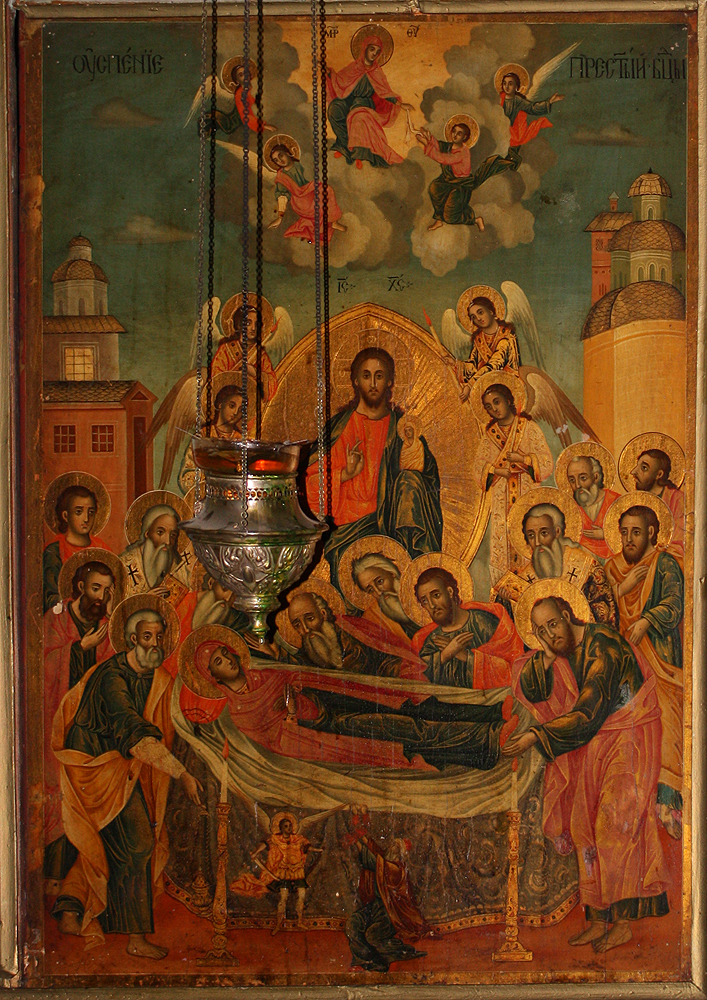
安眠聖像(Icon of the Dormition)則將這一神學以視覺方式表達得淋漓盡致。在傳統的聖像構圖中,聖母的身體橫臥於床榻之上,眾使徒環繞哀悼;而在她身後,基督站立於榮耀之中,雙臂懷抱著一個身披白衣的嬰孩——那是聖母的靈魂。這幅聖像構成了一種意味深長的「逆轉」:當聖母在聖誕之時懷抱聖嬰,如今她的聖子在安眠之際懷抱她的靈魂,正如她曾經懷抱祂。
值得注意的是,正教聖像中聖母的身體從未被直接升入空中,而是安放在床榻上——她真實地死去了。基督緊抱著她的靈魂,而非一具未經死亡的身體。這一圖像無聲卻有力地拒絕了任何試圖將聖母的終局與死亡分離的神學建構。塞拉芬‧羅斯神父(Fr. Seraphim Rose)曾寫道:「當教會在她的禮儀和聖像中告訴我們,使徒們被奇蹟般從地極聚集,目睹誕神女的安眠與安葬,我們正教基督徒便不自由否認或重新解釋這一點,而必須以樸素之心相信教會所傳遞給我們的一切。」
結論:從「安眠」到「升天」——兩種救恩論視野的交滙
綜上所述,天主教1854年聖母無染原罪信理的正式定義,並非一個孤立的聖母論議題,而是深刻地衝擊並重塑了東西方教會對「聖母安眠」這一古老傳統的理解框架。無染原罪信理所植根的奧斯定式原罪論,將瑪利亞的純潔定位於受孕瞬間的「法律性豁免」(「先贖論」),由此形成了一條邏輯鏈條——因為無染原罪,所以免於腐朽;因為免於腐朽,所以肉身直接升天。在這一鏈條上,「安眠」的核心——聖母的真實死亡——逐漸被邊緣化甚至被質疑,古老的「死亡—復活」範式轉變為「直接升天」的敘事,1950年的「升天」信理成為這條邏輯鏈條的終點。
然而,從東正教的視角來看,這一代詞之變——從「安眠」到「升天」——所折射的,乃是東西方教會對「救恩如何臨到人類」這一根本問題的不同回答。西方在天主教框架下傾向於將恩寵理解為一種本體論層面的「預先豁免」——瑪利亞因特殊的法律性恩寵而在墮落人類處境之外享有獨特地位,其終局不經死亡而直接榮召升天。東正教則將恩寵理解為一種人格性的協作關係——瑪利亞與所有人一樣承襲了墮落人性的敗壞(包括必死性),但她以其自由意志終其一生與天主的恩寵合作,從未犯任何實際的罪,最終被聖神所聖化;她的「安眠」正是這一協作關係的最高成全:她在死亡中與她的聖子同死、同復活,成為一切基督徒末後復活的原型與保障。
兩種視野之間,並無妥協的捷徑。因為分歧不在於對聖母尊崇的程度——東正教同樣稱聖母為「至潔無玷者」(Most Holy Immaculate),將其尊崇於一切受造物之上——而在於對「人類如何在基督內蒙受救贖」這一根本命題的理解。在東正教看來,福音的真正喜訊乃是:一位真實經歷了死亡的女人,如今已在基督內被遷移至生命之中;她的「安眠」正是所有在基督內睡了之人終將復活的預表與保證。倘若以無染原罪之名剝奪了她與人類共享的死亡,便同時削弱了她作為人——一位與我們擁有同樣本性的人——所帶來的盼望。
參考文獻
1. Munificentissimus Deus. Apostolic Constitution of Pope Pius XII Defining the Dogma of the Assumption of the Blessed Virgin Mary. 1 November 1950.
2. Ineffabilis Deus. Apostolic Constitution of Pope Pius IX Defining the Dogma of the Immaculate Conception. 8 December 1854.
3. Bartholomew I, Ecumenical Patriarch of Constantinople. “The Dormition of the Theotokos.” 30Giorni, 2010.
4. Bartholomew I, Ecumenical Patriarch of Constantinople. “Orthodox Perspective on the Immaculate Conception.” Interview, OMHKSEA, 2004.
5. John of Damascus. Second Homily on the Dormition. In On the Dormition of the Mother of God, translated by Brian E. Daley. Crestwood, NY: St. Vladimir’s Seminary Press, 1998.
6. John of Damascus. First Homily on the Dormition. Ibid.
7. Breck, Fr. John. “Dormition or Assumption?” Orthodox Church in America, 1 August 2008.
8. Patriarch Daniel of Romania. “Homily on the Dormition of the Theotokos: Virgin Mary is the Living Icon of the Church.” Basilica News Agency, 17 August 2017.
9. Maximovitch, St. John (Archbishop). The Orthodox Veneration of Mary the Birthgiver of God. Platina, CA: St. Herman of Alaska Brotherhood, 1996.
10. Grayson, W.L. “The Dormition of the Virgin Mary.” New Evangelizers, 15 August 2022.
11. Encyclical for the Feast of the Dormition 2011. Greek Orthodox Metropolis of San Francisco, 2 August 2011.
12. “Do Orthodox Believe Mary was Assumed into Heaven?” St. Michael Orthodox Church (OCA), Texas, 2025.
13. “The Dormition of the Most Holy Theotokos.” Orthodox Metropolitanate of Hong Kong and Southeast Asia (OMHKSEA), 15 August 2023.
14. Gillquist, Fr. Peter E. Becoming Orthodox: A Journey to the Ancient Christian Faith. Ben Lomond, CA: Conciliar Press, 1989.
15. Lossky, Vladimir. The Meaning of Icons. Boston: Boston Book and Art Shop, 1969.
—
In the history of Christian theology, the year 1854 marks a profound watershed. On 8 December of that year, Pope Pius IX promulgated the Apostolic Constitution Ineffabilis Deus, solemnly defining the Immaculate Conception of the Blessed Virgin Mary as a dogma of the Catholic faith: “The most Blessed Virgin Mary, in the first instant of her conception, by a singular grace and privilege granted by Almighty God, in view of the merits of Jesus Christ, the Saviour of the human race, was preserved free from all stain of original sin.” Although this dogma had undergone a lengthy theological gestation within Catholicism, its formal definition posed a profound theological challenge to the Eastern Orthodox Church.
Throughout the long centuries prior, East and West had shared a more ancient tradition—the annual commemoration on the fifteenth of August of the “Dormition of the Mother of God” (Koimēsis). This tradition, traceable to the fifth century or even earlier, has a clear core meaning: the Mother of God truly underwent death, her body was laid in a tomb, and subsequently her soul and body were translated into heaven by her Son. It is a mystery of “death and resurrection,” with the Theotokos as the prototype, foreshadowing the hope of the final resurrection for all Christians.
Yet once the Immaculate Conception formally entered the Catholic dogmatic system, a new theological chain of logic began to form: if Mary was utterly free from original sin, then she ought not to be subject to the penalty of original sin—the corruption of death. This logic bore fruit nearly a century later: in 1950, Pope Pius XII issued the Apostolic Constitution Munificentissimus Deus, defining the Assumption as a dogma and explicitly binding the two dogmas together—“she, by her Immaculate Conception, completely overcame sin, and therefore was not bound by the law of remaining in the corruption of the grave nor of awaiting the final redemption of the body.”
This article , adopting an Orthodox perspective, intends to examine how the definition of the Catholic dogma of the Immaculate Conception hit and reshaped the theological framework for understanding the ancient tradition of the Dormition of the Theotokos, and to expound systematically the Orthodox theological stance and response.
1. The Ancient Tradition of the Dormition: Death as a Passage of Glory
The Origin and Content of the Dormition Tradition
The historical roots of the Dormition tradition extend far earlier than any dogmatic definition. Already in the fifth and sixth centuries, writings attributed to Saint Melito of Sardis, Saint Dionysius the Areopagite, and others record the commemoration of the Mother of God’s falling asleep. By the eighth century, Saint John of Damascus and his brother Saint Kosmas, in their homilies on the feast, provided a detailed theological exegesis that became the classical expression for subsequent generations.
According to the Church’s tradition, the Theotokos spent her final years in Jerusalem, cared for by Saint John (the Apostle). Three days before her departure, the Archangel Gabriel appeared to her, announcing her imminent translation to eternal life. The apostles were gathered from the ends of the earth by clouds to Jerusalem and witnessed her Dormition. Three days later, when the Apostle Thomas arrived late and the tomb was opened, her body was found to be no longer there—her Son had taken her into heaven.
The Essence of the Dormition Theology: the Reality of Death
The core of this tradition rests upon a seemingly simple yet essential proposition: the Mother of God truly and really experienced death. Saint John of Damascus writes: “If her incomprehensible Fruit, on account of which she was called heaven, willingly submitted to the tomb, how should she refuse the tomb, who gave birth without union?” He further explains: “It was fitting that she who was made of earth should return to earth, and thus ascend to heaven, having embraced the heavenly life on earth through the mortification of the flesh.” “It was fitting that the body should be cleansed through death, as gold through the furnace, and cast off the dark and gross burden of corruption, and then arise from the tomb incorruptible, pure, and illumined by the light of immortality.”
In the liturgy of the Orthodox Church, this conviction receives its most vivid expression. The Kontakion of the Feast of the Dormition proclaims: “The grave and death could not hold the Theotokos, who is sleepless in her intercessions and an unfailing hope in her protections. For as the Mother of Life, He who dwelt in her ever-virgin womb translated her to life.” Likewise, the Ninth Ode exclaims: “From the Virgin’s birth and death, the guarantee of life has been shown.”
“Dormition” Rather Than “Assumption”: the Theological Significance of the Terminology
It is worth noting that the Eastern tradition deliberately chose the term “Dormition” (Koimēsis) rather than “Assumption” (Analēpsis) to describe this mystery. Patriarch Daniel of Romania has explained clearly: the translation of the Theotokos is neither a resurrection—since she did not appear in a risen body as Christ did—nor an ascension—since she did not ascend by her own power but was taken up by her Son.
St. Michael’s Orthodox Church in Oklahoma City further clarified the key theological distinction between the Dormition and the Catholic Assumption: the 1950 Catholic dogmatic definition did not definitively determine whether the Mother of God actually died, saying only that she “completed the course of her earthly life”; the Orthodox Church’s teaching firmly maintains that she indeed died. “She shared fully in our human condition. But death could not hold her. Christ raised her up, even as He will raise us. We also do not hold this as a dogma in the Catholic sense. This was not something a pope declared infallible in 1950. This is simply what the Church has always believed, prayed, and sung.”
2. From Dormition to Assumption: the Immaculate Conception Dogma’s Reshaping of the Ancient Tradition
The Theological Logic of the Immaculate Conception and the Problem of Death
The core proposition of the 1854 Catholic dogma of the Immaculate Conception is that Mary, from the very first moment of her conception, was preserved immune from all stain of original sin. This proposition is rooted in the Augustinian doctrine of original sin, which holds that original sin is not only a state of corruption but carries a certain character of guilt that is transmitted to all human descendants through generation.
However, the definition of this dogma immediately raised an inescapable theological question: if Mary is utterly free from original sin, must she still undergo death, the wages of sin? As Saint John of Damascus insisted, death is a universal consequence of fallen humanity; the Theotokos, sharing our human nature, ought rightly to undergo death like all others. Under the framework of the Immaculate Conception, a fundamental fissure appears between Mary’s human condition and that of the rest of the human race.
Catholic apologists have faced a dilemma on this question. On the one hand, admitting that Mary died seems to concede that the consequence of original sin touched this Immaculate one; on the other hand, denying her death risks crossing the boundary of the analogy between Mary and Christ, attributing to her a quasi-divine status. This difficulty led Munificentissimus Deus in 1950 to deliberately choose an ambiguous phrase—“completed the course of her earthly life”—neither explicitly affirming nor denying death.
The Systematic Displacement of the Dormition by the Assumption Dogma
The formal definition of the dogma of the Assumption in 1950 marks Catholicism’s systematic reshaping of the ancient Dormition tradition. In the Apostolic Constitution, Pius XII explicitly links the Immaculate Conception and the Assumption into an inseparable theological chain: because Mary was immaculately conceived, she was not subject to the law of bodily corruption and had no need to await the final resurrection in the tomb. “These two privileges are most closely united with one another.”
Under this logic, the core of the Dormition—the real death of the Theotokos—has gradually been downplayed or even questioned. Catholic apologists such as W.L. Grayson have pointed out that a long-standing view within the Catholic Church holds that death is a consequence of original sin; since Mary was completely sinless, death had no rightful claim on her. To explain her death, one can only appeal to the model of Christ’s voluntary death—that is, Mary did not die of necessity, but voluntarily chose to follow her Son into death. This explanation ostensibly retains the language of “death,” but in moving from “necessity” to “voluntariness” it fundamentally dissolves the core of the Dormition tradition: the death that the Theotokos experienced “just as all do,” as the representative of humanity.
An even more significant shift has occurred at the level of liturgy and terminology. The Western Church has increasingly substituted “Assumption” for “Dormition” as the official designation of the feast, moving the theological emphasis from “death and resurrection” to “immediate ascension.” As the American Orthodox theologian Fr. John Breck observed: “Several sincere but misguided interpretations of Mary in the West tend to exalt the Most Holy Virgin to a kind of ‘divine’ level, effectively erasing the vital and absolute distinction between the human and the divine.”
The “Preredemption” Theory and the Tendency toward an “Automatic” Grace
The “Preredemption” theory proposed by the Catholic theologian Duns Scotus attempted to resolve an obvious tension: if Mary was preserved immune from original sin from the first moment of her conception, did she still need Christ’s redemption? Scotus’s solution is that Mary equally needed redemption, but she received that redemption “in advance” in a more excellent manner through the merits of Christ.
From an Orthodox perspective, however, the problem with this line of reasoning is that it quietly transforms the action of grace from a personal encounter and cooperation (synergeia) into an ontological property that takes effect automatically. The Ecumenical Patriarch Bartholomew I of Constantinople, in an interview, pinpointed this difference precisely: “For us Orthodox, what original sin transmits is corruption, not legal guilt or a moral stain.” “The Most Holy Theotokos was not exempted from the corruption of original sin from the moment of her conception; rather, she loved God with all her heart and kept His commandments, and thus was sanctified by God through Jesus Christ who took flesh from her.” “Her rebirth in Christ, as with all the saints, enabled her to be sanctified above all the saints. The process of her restoration to the state before the fall did not necessarily occur at the moment of her conception. We believe that this process took place later, through the gradual operation of uncreated grace in her, and through the coming of the Holy Spirit—the moment when Christ was conceived in her—she was purified from all stain.”
Thus, for the Orthodox, the death in the Dormition does not contradict the Mother of God’s purity—because what she inherited was the common corruption of fallen humanity (including death), not some “guilt” needing to be washed away beforehand. Grace is not a juridical exemption from a “stain of original sin,” but the fruit of a personal cooperation with God—a cooperation that deepened progressively through the free choices of her whole life and reached its fulfillment at the end of her earthly life. Within this framework, the Dormition is precisely the final and highest link of this cooperation: in death, she underwent the Paschal mystery of dying and rising with Christ.
3. The Orthodox Refutation and Theological Position
The Scriptural and Patristic Grounds for Rejecting the Immaculate Conception
The Orthodox rejection of the Immaculate Conception did not begin in 1854; it became more systematic and explicit only after the dogma was promulgated. Prior to that, there had been some openness within Orthodoxy to discussing whether any impurity touched the Mother of God’s conception, but the Catholic definition of 1854 turned this question from a free theological opinion (theologoumenon) into a dogmatic dividing line.
Patriarch Bartholomew, in the interview cited above, clearly expressed the Orthodox position: the Theotokos “by her love for God and her purity—understood as an unshakeable, unreserved dedication of her love solely to the one God—was able, in God’s grace, to sanctify herself in Christ and make herself worthy to become the dwelling-place of God, as God desires each of us to become.” “We in the Orthodox Church honor the Most Holy Theotokos above all the saints, but we do not accept the novel dogma of her Immaculate Conception.”
The scriptural and patristic grounds for this position can be set forth on two levels. On the scriptural level, Orthodox Fathers hold that Luke’s “Hail, full of grace” (Lk 1:28, Catholic translation) does not support the interpretation “preserved from original sin from the moment of conception” but rather indicates that the Mother of God was shown grace before God because of her obedience and faith. On the patristic level, Saint John of Damascus repeatedly emphasizes that the Theotokos underwent a death “according to nature”—she came from “mortal loins,” and the death she underwent was meant “to console all, that they should not fear to enter the kingdom of heaven through the gate of death.” Other Eastern Fathers, such as Saint Ephrem the Syrian and Saint John Chrysostom, likewise do not trace the Theotokos’s purity back to the moment of her conception but stress that she was sanctified through the descent of the Holy Spirit at the Annunciation.
The Fundamental Divergence on Original Sin and Its Influence on the Theology of the Dormition
The divergence between East and West on the question of the Dormition is far from an isolated Mariological issue; it is profoundly rooted in structural differences on the doctrine of original sin.
The Augustinian concept of “original sin” (peccatum originale) emphasizes that Adam’s guilt is transmitted to all human descendants through generation, and human nature consequently bears a “stain.” Within this framework, if Mary were to be a pure dwelling-place for the Word, she had to be exempted from this stain from the first instant of her conception—the Immaculate Conception becomes a theological necessity. And once the Immaculate Conception is affirmed, the penalty brought by original sin (the corruption of death) likewise cannot touch the Mother of God—the Assumption dogma follows as an inevitable corollary.
By contrast, the Orthodox understanding of “ancestral sin” (προπατορικὸν ἁμάρτημα) differs from the Western concept of “original sin.” Patriarch Bartholomew expounds this in detail in his writings: “The image of God is the mold in which humanity was fashioned, with the potential and destiny to become like God. Even after the fall of Adam and Eve, by freely choosing to love God and obey His commandments, a human being can become a friend of God according to God’s will; God would then sanctify them, just as He sanctified many forefathers before the birth of Christ, even though their redemption—their release from corruption—was accomplished through and by the incarnation of Christ.” Orthodoxy holds that the consequence of the fall is death and the inclination toward corruption, not the transmission of personal guilt. Under this framework, the Mother of God, like all human beings, inherited the common consequences of fallen humanity, including the bodily necessity of undergoing death. Her purity derives not from being exempted from a certain “stain,” but from the fact that she, by her free will, chose to offer complete obedience to God, never committed any actual sin, and received her ultimate sanctification through the descent of the Holy Spirit at the Annunciation.
Thus, the death in the Dormition not only does not contradict the Theotokos’s sanctity but constitutes an essential attribute of her role as the representative of the human race: she “shares this lot with all those born of the earth,” physically undergoing the death common to the descendants of Adam, and thereby becomes the “prototype” of all who die and rise in Christ. Vladimir Lossky has pointed out that, from an Orthodox perspective, the Dormition of the Theotokos is “the first eschatological event realized in Christ, foreshadowing the universal resurrection.”
The Dormition as an Indicator of the Rejection of the Methodology of “Doctrinal Development”
The Orthodox attitude toward the Catholic definition of the Assumption dogma (1950) is methodologically identical to its rejection of the Immaculate Conception dogma (1854). Orthodoxy considers that the mode of reasoning used by Catholicism for these two dogmas—logically deducing an implicit truth and finally having it proclaimed as a dogma necessary for salvation by the supreme authority of the Church—essentially departs from the early Church’s model of consensus.
As the Greek Orthodox Metropolis of San Francisco stated in its 2011 encyclical for the Feast of the Dormition: “We Orthodox Christians regard the tradition of the translation of the body of the Theotokos as a commonly accepted belief, but the Church never proclaimed it a dogma or doctrine (the Roman Catholic Church proclaimed it a dogma in 1950). We Orthodox Christians see in the Scriptures the central role of the Theotokos in our story of salvation.” The same principle applies to the Dormition: the Orthodox Church does not depend on a papal brief to “define” whether the Theotokos died or whether she was taken up; these truths are a living tradition handed down through the liturgy (leitourgia), the icon (eikōn), and the consensus of the Fathers (consensus patrum).
This methodological divergence became particularly evident after 1854. The Patriarchal and Synodical Encyclical of 1895 explicitly stated: “The Church of the seven holy Ecumenical Councils teaches that the supernatural conception of the only-begotten Son and Word of God by the Holy Spirit and the Virgin Mary is alone pure and immaculate; the Papal Church, however, scarcely forty years ago made an innovation by laying down a novel dogma concerning the immaculate conception of the Mother of God and ever-Virgin Mary, which was unknown to the ancient Church.”
For the Orthodox, the key issue is not whether the Theotokos is pure—on this point there is no disagreement between East and West—but whether this purity can be defined in a way that amounts to a “juridical exemption at the moment of conception.” The definition of 1854 not only disagrees with Orthodox teaching on original sin in substance, but also constitutes a far-reaching methodological precedent: once such definitions are accepted as legitimate, further deductions along the same logical chain become difficult to limit. The Assumption dogma of 1950 is precisely the natural extension of this methodology.
The Liturgy and Icon of the Dormition as a Tacit Refutation of the Immaculate Conception’s Presuppositions
The most vivid expression of the Orthodox adherence to the Dormition tradition lies not in theological polemics but in its liturgy and icon. Throughout the liturgical texts for the Feast of the Dormition, the twin themes of death and resurrection run continuously. As already noted, the Kontakion proclaims that the grave and death could not hold the Theotokos; the Ninth Ode joins the Theotokos’s death with her birth-giving and calls it the “guarantee of life.” The Theotokos is repeatedly honored in the liturgy as “the Mother of Life”—precisely because she gave birth to the Lord of life itself, death could not become the final word for her.
The Icon of the Dormition expresses this theology visually in the most compelling manner. In the traditional iconographic composition, the body of the Theotokos lies on a bier, surrounded by the mourning apostles; behind her, Christ stands in glory, holding in His arms a small child clothed in white—that is the soul of the Theotokos. This icon forms a profound “reversal”: just as the Theotokos held the Christ-child at His Nativity, so now her Son holds her soul at her Dormition, just as she once held Him.
It is noteworthy that in the Orthodox icon the body of the Theotokos is never shown being lifted directly into the air but rests upon the bier—she truly died. Christ holds her soul, not a body that did not undergo death. This image silently but powerfully refutes any theological construction that would attempt to separate the end of the Theotokos’s earthly life from death. Fr. Seraphim Rose wrote: “When the Church tells us in her liturgy and icons that the apostles were miraculously gathered from the ends of the earth to behold the Dormition and burial of the Theotokos, we Orthodox Christians are not free to deny or reinterpret this, but must in simplicity of heart believe all that the Church has handed down to us.”
Conclusion: From Dormition to Assumption—A Clash of Two Soteriological Visions
In summary, the formal definition of the Immaculate Conception of the Blessed Virgin Mary by the Catholic Church in 1854 is by no means an isolated Mariological topic; it profoundly impacted and reshaped the framework by which the ancient tradition of the Dormition is understood in both East and West. The Augustinian doctrine of original sin upon which the Immaculate Conception dogma rests locates Mary’s purity in a “juridical exemption” (the “Preredemption”) at the moment of conception, thereby creating a logical chain: because of the Immaculate Conception, she was free from corruption; because she was free from corruption, her body was taken up directly into heaven. On this chain, the core of the Dormition—the real death of the Theotokos—becomes increasingly marginalized or even questioned; the ancient paradigm of “death-resurrection” is transformed into a narrative of “immediate assumption”; and the Assumption dogma of 1950 becomes the terminus of this logical chain.
From the Orthodox perspective, however, this shift in terms—from “Dormition” to “Assumption”—mirrors the divergent answers that East and West give to the fundamental question of how salvation comes to humanity. In the Catholic framework, the West tends to understand grace as an ontological “exemption in advance”—Mary, by a special juridical grace, occupies a unique position outside the common fallen human condition, and her end is a direct assumption into glory without undergoing death. Orthodoxy, by contrast, understands grace as a personal relationship of synergy—Mary, like all human beings, inherited the corruption of fallen humanity (including mortality), but she, by her free will, cooperated with God’s grace throughout her entire life, never committed any actual sin, and was ultimately sanctified by the Holy Spirit; her “Dormition” is precisely the supreme fulfillment of this synergistic relationship: in death she died and rose with her Son, becoming the prototype and guarantee of the final resurrection for all Christians.
There is no shortcut to a compromise between these two visions. For the divergence does not lie in the degree of veneration paid to the Theotokos—Orthodoxy likewise calls the Theotokos the “Most Holy Immaculate” and honors her above all creation—but in the understanding of the fundamental question of how humanity is redeemed in Christ. In the Orthodox view, the true good news of the Gospel is this: a woman who truly experienced death has now been translated into life in Christ; her “Dormition” is the prefiguration and pledge that all who have fallen asleep in Christ will finally rise. If, in the name of the Immaculate Conception, she is deprived of the death she shares with humanity, she is at the same time weakened in the hope she brings as a human being—a human being of the same nature as we are.
References
1. Munificentissimus Deus. Apostolic Constitution of Pope Pius XII Defining the Dogma of the Assumption of the Blessed Virgin Mary. 1 November 1950.
2. Ineffabilis Deus. Apostolic Constitution of Pope Pius IX Defining the Dogma of the Immaculate Conception. 8 December 1854.
3. Bartholomew I, Ecumenical Patriarch of Constantinople. “The Dormition of the Theotokos.” 30Giorni, 2010.
4. Bartholomew I, Ecumenical Patriarch of Constantinople. “Orthodox Perspective on the Immaculate Conception.” Interview, OMHKSEA, 2004.
5. John of Damascus. Second Homily on the Dormition. In On the Dormition of the Mother of God, translated by Brian E. Daley. Crestwood, NY: St. Vladimir’s Seminary Press, 1998.
6. John of Damascus. First Homily on the Dormition. Ibid.
7. Breck, Fr. John. “Dormition or Assumption?” Orthodox Church in America, 1 August 2008.
8. Patriarch Daniel of Romania. “Homily on the Dormition of the Theotokos: Virgin Mary is the Living Icon of the Church.” Basilica News Agency, 17 August 2017.
9. Maximovitch, St. John (Archbishop). The Orthodox Veneration of Mary the Birthgiver of God. Platina, CA: St. Herman of Alaska Brotherhood, 1996.
10. Grayson, W.L. “The Dormition of the Virgin Mary.” New Evangelizers, 15 August 2022.
11. Encyclical for the Feast of the Dormition 2011. Greek Orthodox Metropolis of San Francisco, 2 August 2011.
12. “Do Orthodox Believe Mary was Assumed into Heaven?” St. Michael Orthodox Church (OCA), Texas, 2025.
13. “The Dormition of the Most Holy Theotokos.” Orthodox Metropolitanate of Hong Kong and Southeast Asia (OMHKSEA), 15 August 2023.
14. Gillquist, Fr. Peter E. Becoming Orthodox: A Journey to the Ancient Christian Faith. Ben Lomond, CA: Conciliar Press, 1989.
15. Lossky, Vladimir. The Meaning of Icons. Boston: Boston Book and Art Shop, 1969.
 正教信仰之路:拉匝祿神父 (長袍修士) 的信仰分享
發表留言